Foreign-trade zones and CPSC eFiling: getting ready for 8 January 2027
Most importers have filed CPSC certificate data since July 2026. Goods entered from foreign-trade zones were given until January 2027. That date is now weeks away.
Published 3 November 2026 · last reviewed 3 November 2026
Short answer
Short answer: Under CPSC’s certificates rule, eFiling applies to CPSC-regulated products entered from a foreign-trade zone (FTZ) for consumption or warehousing from 8 January 2027. From that date, those entries need the certificate data, either the full data set or a CPSC Product Registry reference, just like other imports. Goods already in the zone are affected when they are entered on or after that date.
What the rule says
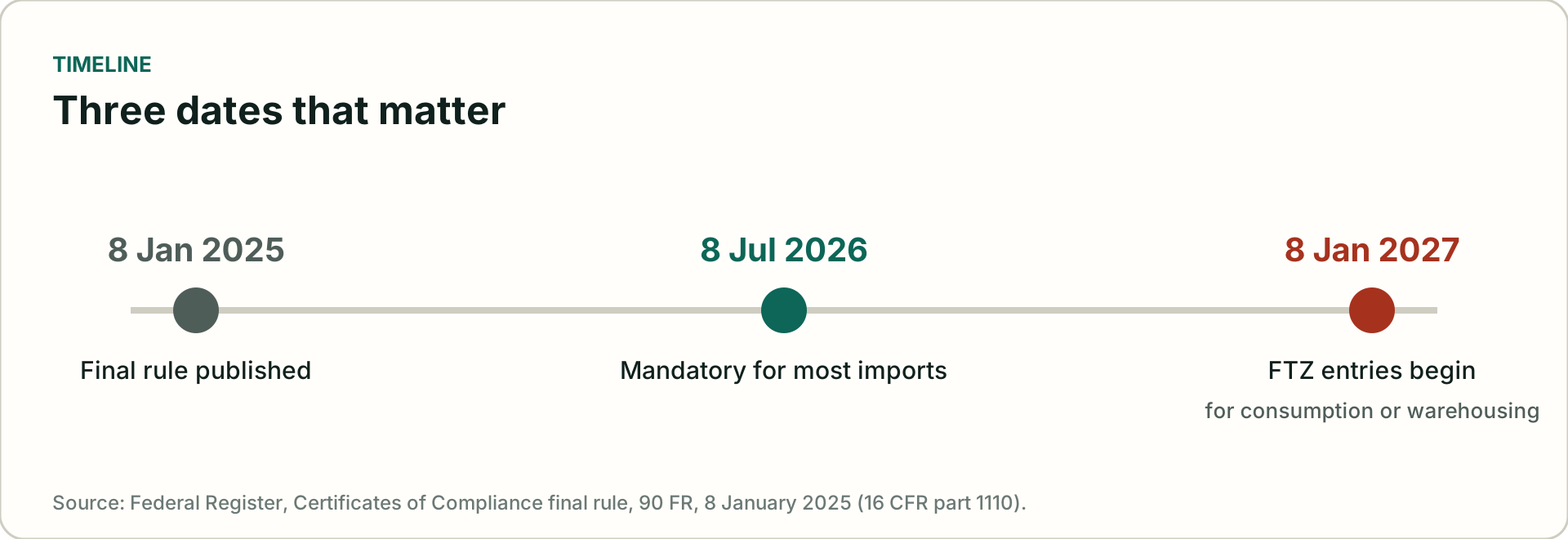
The final rule published on 8 January 2025 made eFiling of certificate data mandatory 18 months later, on 8 July 2026, for most imports. For CPSC-regulated products “entered from an FTZ for consumption or warehousing”, the rule takes effect on 8 January 2027, 24 months after publication (Federal Register).
Nothing else changes for FTZ goods: the same certificate data elements in 16 CFR part 1110 apply (product identification, rules cited, certifier, records contact, date and place of manufacture, date and place of testing, and the lab), and the same two filing methods are available, the full message set or a Product Registry reference.
Where it fits in the FTZ flow
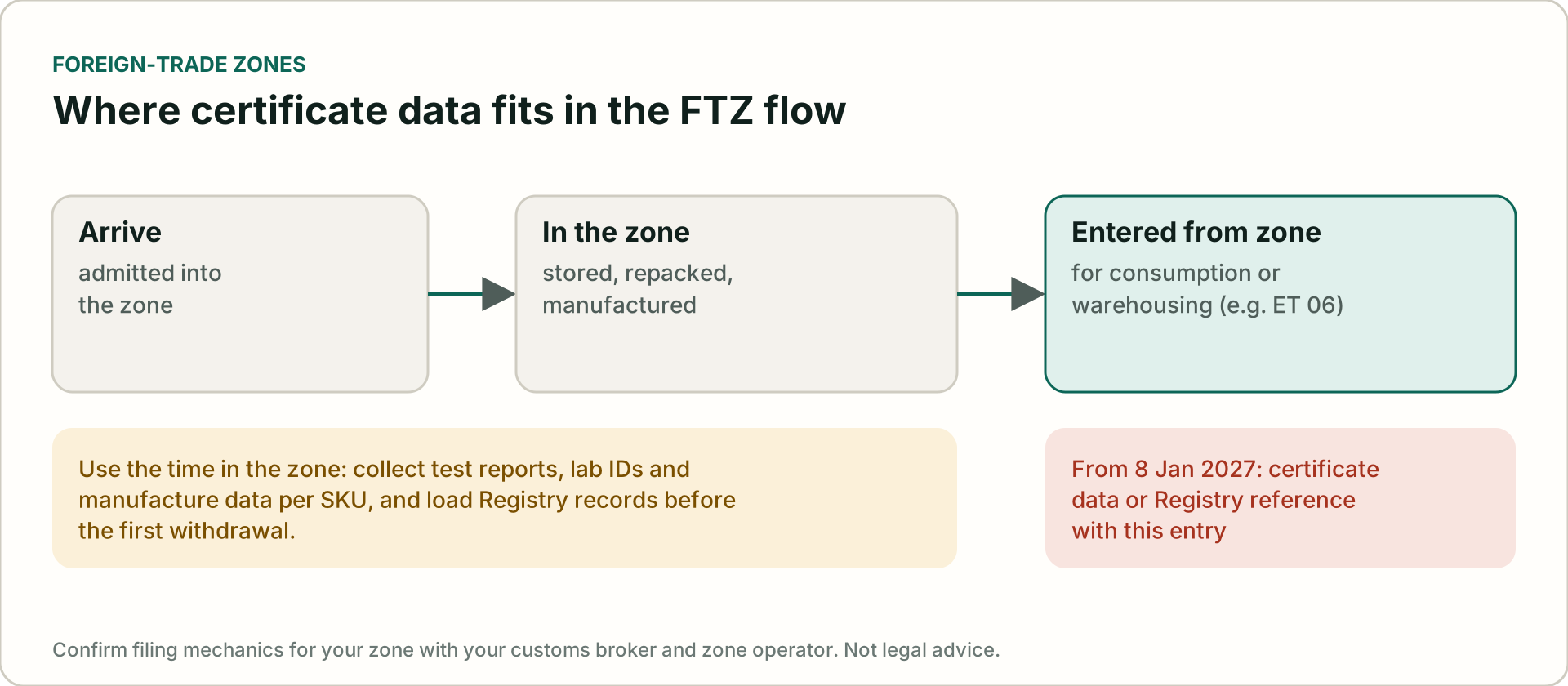
Exact filing mechanics depend on your zone procedures and your broker’s software (CPSC’s eFiling hub has the importer and broker pages), so confirm with your customs broker and zone operator how the CPSC data will be transmitted for your zone entries. Industry guides describe the timing in slightly different ways; the rule text ties the date to entries from the zone for consumption or warehousing.
A six-week plan
- Week 1: list every SKU in the zone and expected to enter after 8 January 2027, and mark which are CPSC-regulated (see CPSC eFiling explained).
- Week 2: collect the certificate (GCC or CPC) and test reports for each regulated SKU.
- Week 3: check each lab’s status and scope (how to check a lab ID).
- Week 4: fill and check the data elements field by field (data elements guide).
- Week 5: load Product Registry records if you will use reference filing, and send the broker a reference ID to SKU map.
- Week 6: run one test entry with your broker before the first real withdrawal.
Pitfalls
- Manipulated or assembled goods: if goods are repacked, kitted or manufactured in the zone, make sure the certificate describes the product as it is actually entered.
- Old test reports: goods stored for a long time may have certificates based on reports that are out of date for periodic testing (children’s products).
- Assuming HTS flags settle it: CPSC flags HTS codes for review, but the importer still decides whether a product needs a certificate.
- Leaving it to the last week: the broker needs clean data before the entry is filed.
Questions importers ask
When does CPSC eFiling start for foreign-trade zones?
On 8 January 2027, for CPSC-regulated products entered from an FTZ for consumption or warehousing.
Do goods already in the zone need certificate data?
If they are entered from the zone on or after 8 January 2027 and are CPSC-regulated, the entry needs the certificate data or a Product Registry reference.
Can we use the Product Registry for FTZ goods?
The rule provides the same two methods for all covered entries: the full message set or a Registry reference. Confirm with your broker how it works for your zone entries.
Does eFiling change what must be tested?
No. eFiling changes how existing certificate data is transmitted, not which products need certificates or what tests apply.
A plain-language guide, not legal advice and not an official CPSC publication. eFiling Ready is not affiliated with CPSC or CBP. Always confirm requirements with CPSC and your customs broker.
Have FTZ inventory entering after 8 January?
A Quick Check reviews up to 10 SKUs against your certificates and test reports and gives every SKU a status, the source page and a next step. $290, next business day.