CPSC eFiling for children’s products: a practical checklist
Children’s products carry the strictest certificate requirements, and since July 2026 every gap shows up in the data sent with each entry. Use this list before your next shipment.
Published 3 November 2026 · last reviewed 3 November 2026
Short answer
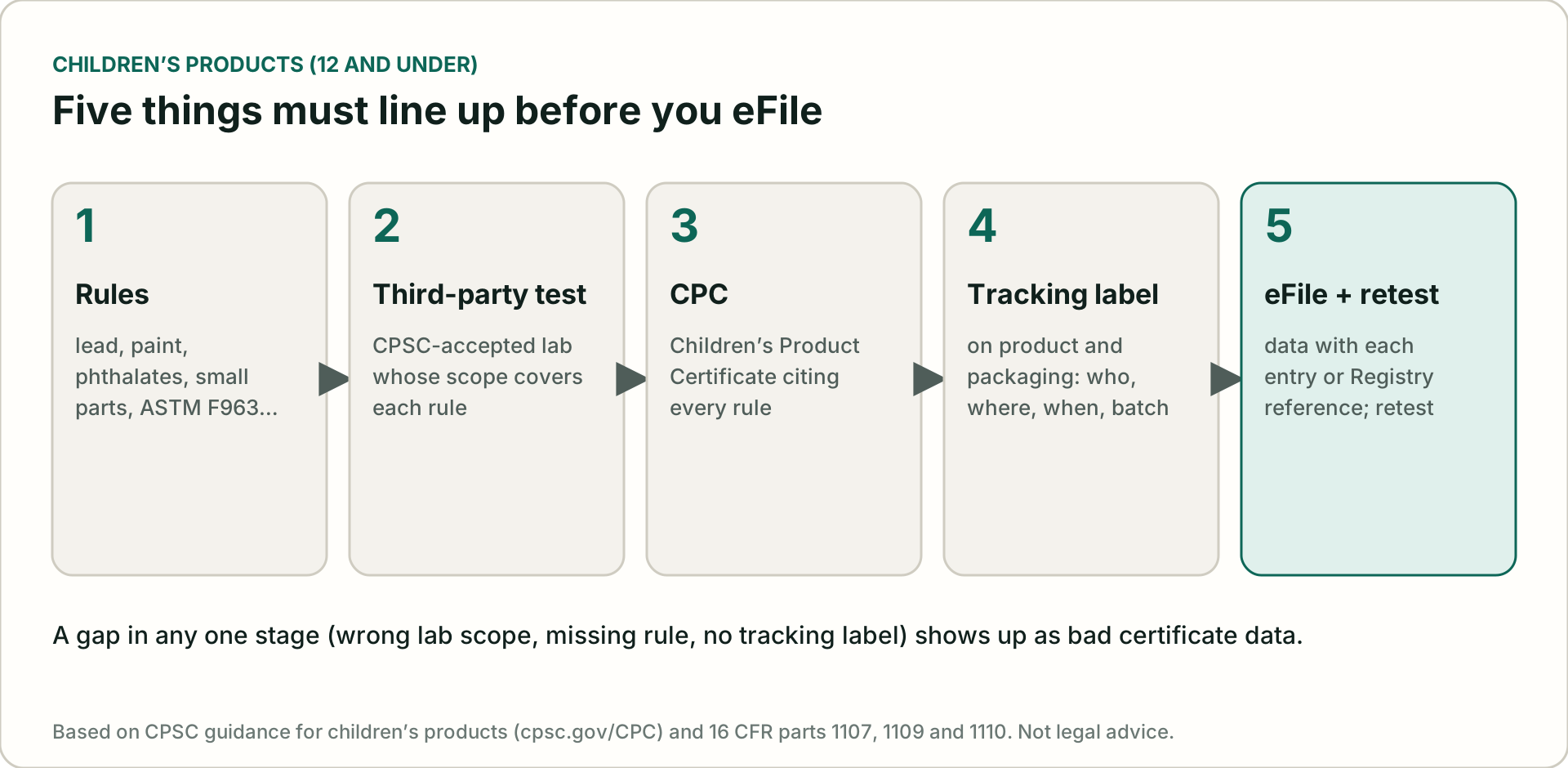
Short answer: Children’s products (designed or intended primarily for children 12 or younger) need a Children’s Product Certificate based on testing by a CPSC-accepted third-party lab, permanent tracking labels on the product and packaging, and periodic retesting. Since 8 July 2026, under the Certificates of Compliance rule (16 CFR part 1110), the certificate data, including the lab’s CPSC ID, must be eFiled with each entry or referenced from the CPSC Product Registry.
Is it a children’s product?
Under the Consumer Product Safety Act, a children’s product is one designed or intended primarily for children 12 years of age or younger. CPSC looks at the manufacturer’s statement, packaging and marketing, whether it is commonly recognised as for children, and age-grading guidelines. A product used by adults and children alike, such as a general-use water bottle, is usually not a children’s product; one sold with cartoon characters for a child’s lunchbox likely is. If you are unsure, see CPC vs GCC and confirm with your lab.
The five-part path
Rules that often apply
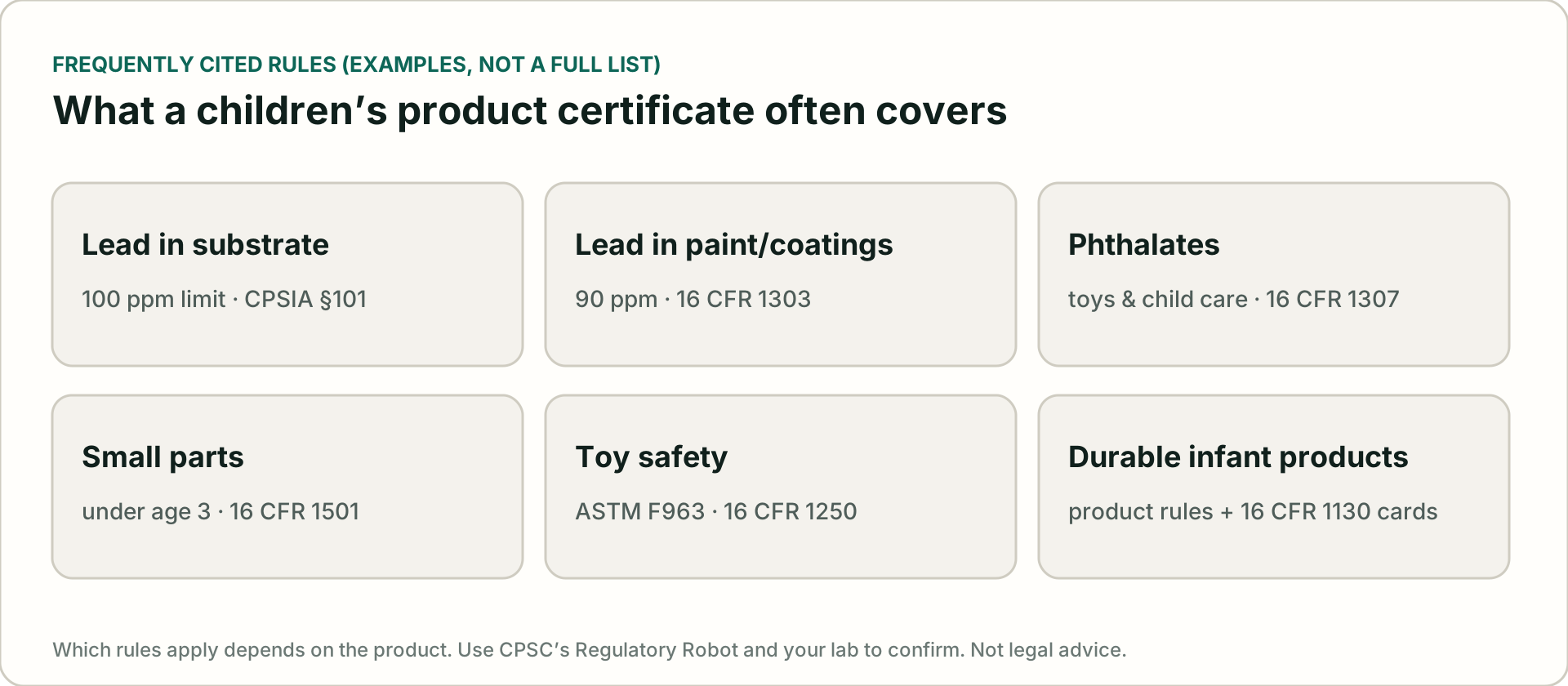
CPSC’s Regulatory Robot (linked from the CPSC eFiling hub) asks a short set of questions and lists rules that may apply. Your lab should confirm the final list, and every rule you certify to must appear on the certificate and in the eFiling data.
Tracking labels
Children’s products and their packaging must carry permanent, distinguishing marks (“tracking labels”) that let you and consumers work out the manufacturer or private labeler, where and when the product was made, and batch or run details, to the extent practicable. Your tracking label data should match the date and place of manufacture in your certificate data. Mismatches are an easy way for problems to surface.
Periodic testing
Children’s products must be retested periodically, not only once. Under 16 CFR part 1107 the general rule is at least once a year, with longer intervals allowed in specific conditions (for example with a production testing plan). Retests also matter when materials, suppliers or the design change: any of those can make the old report a weak basis for the certificate.
Track the next retest date for each SKU next to its certificate. When a new report arrives, issue a new certificate version and update your Product Registry record.
Pre-shipment checklist
- Children’s product status confirmed and documented.
- Every applicable rule listed on the test report and the certificate.
- Lab is CPSC-accepted, the scope covers each rule, and the lab ID is recorded (see how to check a lab ID).
- Date and place of manufacture match the tracking label and purchase records.
- Certifier and records-custodian contacts are current.
- Product Registry record or full data set ready for your broker before arrival.
- Next retest date recorded.
Questions importers ask
What age counts as a children’s product?
A product designed or intended primarily for children 12 years of age or younger.
Can a children’s product be tested by any lab?
No. Testing must be done by a third-party lab that CPSC has accepted for the relevant test methods. The lab’s scope must cover each rule on the certificate.
Do children’s products need a certificate for every shipment?
The certificate must accompany the product and, since 8 July 2026, its data must be eFiled with each entry or referenced from the Product Registry.
How often must children’s products be retested?
Periodically. The general rule in 16 CFR part 1107 is at least once a year, with longer intervals in specific conditions, and retesting is also needed after material changes.
A plain-language guide, not legal advice and not an official CPSC publication. eFiling Ready is not affiliated with CPSC or CBP. Always confirm requirements with CPSC and your customs broker.
Preparing certificate data for a children’s range?
Certificate Preflight checks 25 SKUs field by field against your test reports and certificates, with a source page for every value. $890, 3–5 business days.